September 12, 2013

Quality is Job One

Back when I was growing up in Chicago, I used to describe what my mom did for a living as "teaching teachers how to teach."  Little did I, or she for that matter, know that she was also teaching her son how to teach.  Hearing story upon story of her drive up and down the length of Chicago (usually avoiding such high traffic areas such as the Kennedy or Dan Ryan) on Western Avenue or Halsted Avenue visiting her student teachers and recent graduates, I was privy to a daily report of the problems, inequities, successes and failures of 1970s-80s Chicago Public Schools from not just one side of town, but from the entire city. Hearing about such a diverse array of neighborhoods and schools was something that only in retrospect I realize was unique.  Most people only have experiences with their local schools directly, or on the peripheral, the larger system as a whole.  There are many in urban areas who have zero experience with public schools. With that background, coupled with my own practice in the classroom both in Chicago and Los Angeles, as well as my research and doctoral work in Philadelphia I should merit standing to be able to make the assertions I am about to make in this blog.  I'm sure, for some of you, my experiences will only count as an outlier or aberration.  For that, let me only say, in the words of Lonnie Rashid Lynn (aka Common), one day it'll all make sense.

I recently heard a piece on WBEZ (http://tinyurl.com/pupl9dt) about the push for teacher quality in the state of Illinois and how an unintended consequence of raising the entrance test scores on the Test of Academic Proficiency (TAP) has created a racial gap among new teachers.  Let me first say that for the past ten years I have noticed, perhaps because I've frequently been one of the few Blacks let alone males in the room, this phenomenon up close and personal.  It is an imperfect storm.  As teachers from the 1960s, 70s, and 80s, the same ones my mom used to mentor and teach, retire, the incoming mix of teachers has becoming increasingly monolithic.  One of the negatives (and yes, we can argue there are many more) about Teach for America is that they have contributed greatly to the "whitening" of the teaching population.  According to the National Center for Education Statistics, as of 2010 (the latest numbers), the teaching population is only 7% Black. Further, even more problematic is that out of the approximately 235,000 Black teachers in the country, only 58,000 are male.  No wonder I was one of only the few in the room.  According to the documentary (which I HIGHLY recommend, American Teacher), the numbers are even more depressing.  In 1970, 34% of the teaching population was male.  In 2002, that number was 22% and today, it sits at an alarmingly low 16%. In fact, statistics such as these are the reason why it was so difficult for me to leave the classroom and start my PhD program. I didn't want to leave my students of color behind.  I came to the realization that having a PhD, and doing the type of research I intend to do will hopefully multiply myself 10 fold.
LAUSD Pay Grid

The WBEZ piece noted that in the past over 60% of Blacks passed the TAP exam.  Today that number is 17%.  As a qualitative person, I want to go beyond the numbers and try to understand what that really means.  Does it mean that there was an over-inflation of Black folk passing the test previously, and now this is a leveling out? Or does it mean that the colleges and universities are grade inflating and those wishing to enter the profession aren't as prepared as previously thought?  Is it a combination of both, neither, something else?  Those are tough questions to isolate.  What is known is that there is a problem.

In Illinois, and elsewhere, the population of white teachers has hovered between 82-85% for decades.  At the same time, we know the population of public school students, particularly in urban areas has becoming increasingly students of color (I would no longer use the word "minority" since they are clearly the majority of the school aged population).  So what can we as educators, activists and politicians do?

I strongly believe that we need a minority equivalent to Teach for America.  I also believe that we need to cease this us versus them mentality when it comes to veteran educators versus first year teachers.  I also feel that, much in the same way as there is a dearth of Black baseball players, some argue, because of the minor league system, some students of color feel as if the road to becoming a teacher is too long for the amount of pay on the front end.  Thus a program like TFA would serve as an alternative route, and of course tackling the challenge of teacher pay would be another.  Scholars such as Dr. Linda Darling-Hammond and others have also recommended a review of teacher pay.  We can no longer simply live by an outdated model of the current grid structure (see above LAUSD grid as an example).


As the Black teaching population continues to age out of the profession, I think having an honest, serious discussion of what, in the 21st century, does it mean for teachers of color to teach students of color.  In addition, let me be clear. I, by no means am disparaging white teachers who continue to serve students of color with honor and high expectations. In fact, my own schooling is littered with many such examples. Perhaps it is an expectations problem. In too many cases, for too long we have had low expectations of our teachers, and they, in turn, have had low expectations regarding their students.  When we examine good schools, two things are always present, high expectations and trust.  Let's trust that as we raise the bar for teachers, they will in turn raise the bar for their students.

September 4, 2013

Waiting for Tom Petty


Photo from 20th Century Fox
Having finally watched the film "Won't Back Down" over the long holiday weekend, I have to say that, while it does delve into cliches just a bit, it brought back memories of the my own experiences in the ed reform struggle. What was poignant was how the film tried to present the various sides of the education reform issue through the lens of different individuals.  What was crystal clear is while many unions dismissed this film, and of course their rank and file followed, the one thing we should be able to agree upon is that the venom, animosity, and vitriol pertaining to education reform has reached a nadir.

What I find so confusing and dare I say, hypocritical is that too many people who claim to "want what's best for children" somehow seem to be the ones who mirror their actions.  I remember in 1989 when the book "All I Really Need to Know I Learned in Kindergarten" by Robert Fulghum first came out, people were really focused on simplification.  Be kind to one another.  Treat others the way you'd like to be treated. Coincidentally, in 1989 the Berlin Wall also came down thus signaling the beginning of the end of the "Cold War."  Since we as Americans no longer had a common enemy, perhaps we lost our focus concerning the exact points Fulghum was aiming to address.

Put simply, on the micro level in the education reform arena and in the macro level as a country, we have lost our humanity towards one another.  Especially when it comes to those with whom we disagree.

As we exited the "greed is good" anything goes Yuppie era of the 1980s and entered the somewhat progressive 1990s with the election of Bill Clinton (before the scandals), there was a hope that things could change.  We had witnessed history take place on the other side of the globe and for those of us exiting college during this time, we truly believed we could make a significant difference.  A 1960s ethos was building around those of us in our 20s.  For example, a young idealistic woman from Princeton wrote an undergraduate thesis proposing that because of a growing teacher shortage, high achieving college graduates should have a way to enter the classroom to teach in underserved areas of the country.  This idea, as we of course know, ended up changing the face of public education, depending on your perspective, for better or worse.

So where are we now, some 20 plus years later post 9/11/01, or more importantly post 9/12?  Because of various events which have taken place both in this country and internationally, we are living in a cloud of fear. We are in an era in which the simplistic assertion of if you're not "with me, you're against me" is the prevailing mantra.  It is as if we've become a nation filled with Hatfield vs McCoys, Yankees vs Red Sox, or White Sox vs Cubs.  Life is one big game (yes, as I said in an earlier post, sometimes a "zero sum game"), and yes there are "winners" and "losers."  But to think that we have lost our sense of sportsmanship, humanity and common sense is extremely disheartening.

The film "Won't Back Down" is just one of the latest examples of a Hollywood cinematic representation of what is occurring in too many cities in this country when it comes to public policy debates as a whole and educational reform policy specifically.  So what is the "solution?"  Simply put listen more, talk less.  And that includes this blogger.

More complexly, I believe that finding the good in others is not something that is easily achieved.  A coach who has walked the sidelines of both Chicago and LA with much success is in such high demand because he has been able to accomplish this task to the tune of 11 NBA Championships.  If it were easy, every coach would follow suit - especially those who succeed in his mammoth footsteps.
Photo from 20th Century Fox

In public education, regardless of your positions on charters, high-stakes testing, state capitals funding public education (or not), Washington DC (reauthorization of ESEA), Department of Education, Common Core or whatever the issue may be, let's begin to find the humanity in those with whom we seemingly are in opposition.  We must remember, we are all searching as best we can, for "what's good for the children."

August 29, 2013

Relaunch of Rhoden's Blog...Version 2.0...or is it 3.0?!?!


This is the relaunch of my blog...again!  

I have been away for a while because of several life changing events.  Those of you who know me, know that I have recently relocated to the Phoenix area while still continuing to finish my dissertation.  Driving cross country (2x actually) has reawakened my broad sense of perspective allowing me to see things from an even more national perspective.  Driving through those "fly over" states of Oklahoma, Iowa, Nebraska and the like and listening to the talk radio for as long as I could stand, has informed me in ways many of us who reside on the coasts or in the major cities never get to be exposed.  Consequently, rather than the rant I was going to post about the good, bad and the ugly surrounding my 6+ years in the city of "brotherly love," I am showing some love and keeping my mouth shut about the ills of Philly for once. Instead I'm going to talk about two issues regarding educational reform that are close to my heart. Rather than addressing the biggest issue this summer, the budget crisis in my former city, this post is about character education, and testing.

Character education is a controversial subject for some.  Many feel those of us who advocate for character education somehow do not understand that, yes, students do need to learn the basics of schooling and that yes, poverty, inequity, and violence exists in too many children's lives.  What gets lost in translation is that there is a vocal few who want to prescribe an either/or approach to education reform.  For example, some would advocate we either have to have character education or high stakes testing.  We either have to have traditional education (reading, writing, math), or we have to spend time building children's self efficacy and esteem.  This false dichotomy leads many to throw up their hands and reduce character education to an after-thought - something that because isn't "tested" is considered unnecessary.  I and others who advocate for this type of pedagogy believe that it is essential, not just for the student's social self, but also their academic selves.  According to an article in Education Week from earlier this year (http://tinyurl.com/mus4t7g), character education has the potential to positively change children's negative behaviors.  While I am not here to advocate for one singular approach to education, I do believe that implementing character education from an early age will show positive effects on students and schools, both academic and socially, in the long run.  

The other, somewhat more controversial topic is, in the words of one of my former Principals, testing, testing, testing. According to an AP-NORC poll, a majority of parents are in favor of standardized testing. If you don't believe me, here is the article (http://tinyurl.com/kqmr5s8).  What this means is that those teacher advocates in Seattle and elsewhere who are directing their parents and children to boycott high-stakes test are an anomaly and there is a silent majority of parents out there who believe testing is important to their child's schooling. Overwhelmingly, 75% of parents believe standardized test are a solid measure of their children's academic abilities. What was not asked in the survey, and is perhaps more problematic, is the incessant test prep which has taken over too many aspects of schooling in poor urban, underperforming schools.

Putting these two situations into context, what seems to be the case to this educator is that there are some things which the progressive establishment, including teachers unions, many outspoken rank and file members, and allies want us to believe is that theirs is the "correct path" towards reform.  While I do consider myself among the ranks of the progressive left, I do not believe that the path to education reform is linear, nor universal. Rather, I believe the best way to describe the current state is that in large part to too many cooks who don't know how to boil water, are making wrong turns and moving in the wrong direction.  

Wouldn't teacher's valuable time be better spent, not test prepping students for these high-stakes exams - which let me stress, I am NOT in favor of, nor begging for parents to "boycott" them, but instead spending their professional development and other limited time creating and advocating for better testing instruments themselves? Wouldn't it be far more prudent for those teachers, advocates and administrators who dismiss character education as "soft" or non essential, to at least examine the validity of those who believe it is extremely vital and critical not just for the student's but for the betterment of the overall climate of their school?

Like I said in the tag line, I am not trying to find a singular answer to the multitude of issues and concerns facing public education, but rather, I am trying to engage the issues in a forum in which a variety of perspectives can be heard and respected. That simple premise is too rare these days. On these two issues, there seems to be only choir director and one note being heard.  Here's hoping that in 2013-14, we can begin to hear other voices in the choral ensemble as well.

PS - the name "Education Provocateur came about from an "exchange" with an advocate from Philly who on twitter thought she was demeaning me by calling me this.  Although she shall remain nameless, I thank her for the compliment!

January 29, 2013

Dear Arne:

Don’t do it!  Don’t fall prey to those with whom, on most issues, we both agree.  Don’t fall into the trap they are setting by using terms like “racial disparities”, “inequities” and “segregation.”  Don’t listen to many well-intentioned but politically naïve people who do not understand how Washington works.  


Friends of Whitney Young High School
Let me be clear.  I am a strong advocate for equitable, good schools.  However, I believe that for decades, many public schools in urban areas, have experienced neglect, disorganization, lack of infrastructure, safety concerns and the like. Unfortunately, the suit being brought forth by community activists from 15 cities (including my hometown and yours of Chicago, as well as Philadelphia, where I currently reside) is without merit, has the potential to be detrimental to educational reform for decades and is not in the best interest of those with whom the plaintiffs think they are defending – young children of color from urban neighborhoods in this country. (see: Education Department to Hear School Closing Complaints - NYT 1-29-13)

Here is the simple assertion, in many urban areas, poor performing schools are concentrated, for the most part, in poor performing neighborhoods.  They are asymptomatic of bigger structural inequalities which exist throughout, but are best exemplified through the neighborhood school – specifically the high school since there are fewer high schools than other types of public schools.  Whether this is the “fault” of public schools or public policy is open for debate and interpretation.  What is clear is that as long as we have had public schools in this country there has been inequality.  The Supreme Court decision of Brown v Board of Education in 1954 did not “end” inequality; it ended legalized segregation of the races.  Brown did not integrate neighborhoods based on race, class or social standing.  In fact, some would argue that Brown did the reverse; it created inner cities which increasingly became populated with more people of color as “white flight” took place.  What is not discussed openly at least in this country, is that in addition to “white flight,” there was also class flight where middle class black and brown folk also left these neighborhoods as soon as they were able to become “upwardly mobile” with redlining and other restrictions being eliminated.

So what does this all mean for the current state of not just public education, but of urban areas in this country?  We have now, in the wake of the increase in accountability, social media and 24/7 news cycles, become incensed about a problem which has been in the shadows of public policy for decades.  Feigning indignation about this situation now is being tardy to the situation at best, and at worse being, in the words of Holden Caulfield, phony.

So Mr. Secretary, I implore you and Mr. Holder to acknowledge that while school closings are not the most desirable situation, they are an important component to restructuring and rebuilding infrastructures.  Not just for downsizing, or “right sizing” Districts, but also because after years of persistent failure (even before the NCLB era), we cannot afford to continue to do the same thing, change the chairs on the Titanic (by replacing administrators, teachers and the like) and expect students (namely students of color) to succeed.

Beverly Hills High pool/basketball court
Change is hard.  That goes without saying.  What needs to be acknowledged openly is that schools are perhaps the last vestiges of what used to be a cohesive, close knit community.  Schools have served as beacons and anchors of neighborhoods for decades, as in the decades of the 1950s and earlier.  In many higher socio-economic and higher social strata communities, they still do – which is why their schools are not called into question, or being closed.  If there is a “problem” in schools in those areas, the community possesses the social capital to make change happen – both politically and economically.  In many urban school districts however, those conditions of social capital change does not exist. Instead, these schools have been persistently, slowly eroding ever since the tumultuous 1960s and 1970s. 

How long, not long.  How long must we wait to create not just surface change, but long lasting meaningful change that, in the short term, may hurt, may be an affront to our “normal way of doing things,” but in the long run has the potential to transform lives?  Clearly the current structures and systems are inadequate and not working.  Why not take a chance and work together to not fight the closures, but to make sure that they never happen again by supporting good public schools from their inception.  Not only do we need “school reform” we need a serious discussion and commitment to “neighborhood reform” as well.  In order to achieve change, we need to eliminate these types of frivolous, attention grabbing law suits, and being the difficult task of working together.

Sincerely yours,

Stuart Rhoden

October 4, 2012

Miseducation Nation


“This is a song Charles Mansion stole from the Beatles, we’re stealing it back!” – U2

This week’s blog post is a topic that is on the front burner of social media “critics” and hashtag twitter  activists.  There is a strong belief by some that simply by citing the 2009 CREDO Stanford University study which finds that –‘charters only perform 17% better than neighborhood schools’ it is somehow written in stone as a fait accompli.  I do not dispute the accuracy of the research or the methodology – rather, I want to suggest a few things.  One, that the 17% statistic often cited is not a static number but is rather fluid, and  that the rational behind the number itself is misleading, especially in light of another hot topic in education reform/debate, “high stakes testing.”

I find it disingenuous at best that people want to highlight test scores of charter schools while at the same time deriding testing (or as they couch it “high stakes testing”) as a whole.  We cannot look at some schools and say, “they are failing” by citing testing while at the same time arguing for, correctly if I may add, the elimination of the emphasis on high stakes testing in public education.  This railing against the “privatization” of public schooling based on "high stakes test scores" is based on the foundations of a flawed premise.

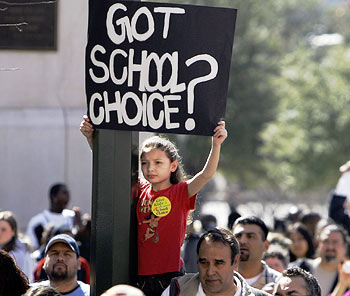
Perhaps if we looked at the graduation rates and college acceptance of charter schools in comparison to their local neighborhood counterparts we'd begin to see a different story.  Examine any city with a significant number of charters and low income, minority neighborhoods, and you will see that charters not only “outperform” their local neighborhood schools. They blow them out of the water.  Let me be clear, I am not advocating for the elimination of neighborhood public schools, quite the contrary.  I am arguing that we need to stop being so divisive about determining what is and isn’t a public school, railing about the closing of one type of school while vigorously promoting the closing of another and instead find commonalities and examine what is working in these (and other) successful schools which are increasing the graduation rates among minority students in impoverished areas.   

It is illogical to argue that charters are “creaming,” “cherry picking” and the like when the pool of applicants for charters (i.e students) have been infected with the same maladies as those who attend the neighborhood schools – poverty, crime, homelessness, hunger, etc.  To simply imply that parents who have placed their children in charters have a higher “social capital” than their non-charter parental counterparts doesn't even come close to being a sufficient argument.

 Some of the findings from the CREDO Stanford Study: (http://tinyurl.com/27k5lkl)
  • Students do better in charter schools over time.   First year charter students on average experience a decline in learning, which may reflect a combination of mobility effects and the experience of a charter school in its early years.   Second and third years in charter schools see a significant reversal to positive gains.   
  •  Charter schools have different impacts on students based on their family backgrounds. For Blacks and Hispanics, their learning gains are significantly worse than that of their traditional school twins.   However, charter schools are found to have better academic growth results for students in poverty.
What is ironic is that nowhere in the Executive Summary of the Report is there a discussion about graduation rates, student/parent satisfaction, or college acceptance.  While this study suggest that the longer students stay in charters, positive gains are more likely, it also critiques Black and Latino student success based on testing.  Nonetheless, simply by examining test scores exclusively, we are stuck gauging public schools (both charters and neighborhood schools) based on a metric which many find offensive, wrong and demeaning both in terms of evaluating teachers AND students.

In a 2011 study done by Mathematica Policy Research which examined  other metrics, they found that by “Applying these methods, we find that charter schools are associated with a higher probability of successful high school completion and an increased likelihood of attending a 2-year or a 4-year college…” (http://www.jstor.org/stable/10.1086/658089)  

Clearly there is a strong movement to examine public schools by metrics other than simply test scores.  While it appears to be socially acceptable to view some public schools (neighborhood) by more than their test numbers, others (charters) are not afforded the same perspective.  Until we can firmly ascertain what our educational aims are – either creating students who perform well on test as a measure of success, or having students achieve high school graduation and college acceptance be the marker, we will continue to languish in the oftentimes contentious debate over school choice and the numbers game.  While we adults, pundits and prognosticators are having this debate, school children all over the country will continue and are continuing to fall through the cracks.  Perhaps, as Paul Tough and other have begun to articulate, it is time we look at character education, grit, resilience and determination in determining "student success" and not just test scores.

Note: To see an example of "success" as well as the vitriolic tone surrounding this debate, see Op-ed from Chicago Sun-Times from Principal of Urban Prep in Chicago. (http://tinyurl.com/8jg9vg2)