Showing posts with label culture. Show all posts

July 3, 2014

Let's Go Crazy

As we enter the full swing of summer for most educators, I wanted to take some time to reflect on some of the conversations in which I have participated in online and in person this past academic year.  As someone who recently relocated as well as finished his dissertation, this year was a year of changes.  However there were some things that remained constant.

People in this country tend to live in boxes.  Not just the houses they inhabit, but mental boxes in which it is much easier, to simply see things that exist as either or propositions.  Either you are with me or you are against me.  Either you are black, or you are white.  Either you are female, or you are male.  This drives me nuts.

Having grown up in the complex world of Chicago – both in terms of race relations/neighborhood divisions, as well as politics, I tend to view the world from a lens of; “yeah, things are bad, they could be worse, now what?”  In other words, let’s get on with the business of doing the hard work of change and while not dismissing historical, structural and institutional ineptitude, bias, racism, sexism or the like, we need to figure out a way to move forward.  The direction we as human beings should be moving is forward. 
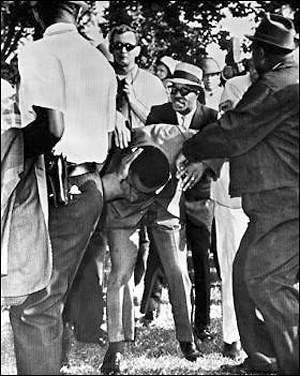
MLK being pelted with Rocks, Cicero, IL 1966
Let me be clear.  That is not to dismiss any of the social justices which occur, it is simply to say, how do we move forward from them?  In too many instances, in the academic arena, in social circles, and on social media, we are too quick to condemn.  Too quick to isolate, and too quick to judge.  In the immortal words of the great 20th century poet, T.A. Shakur  “only God can judge me.”  Further, what is the end result of judgment?  Especially if people are more often wrong than right?

So how does this ethos manifest itself?  There are many who criticize the President’s “My Brother’s Keeper” initiative as being 1) just for boys, 2) putting the onus on the young men as opposed to the structural inequalities which exists and 3) does not allow for minority community groups to engage in the grant process or contribute to the dialogue.  Let me state the obvious.  If dismantling systems and structures were so easy, we would have accomplished our goals decades, if not centuries ago.

What can we do? 

We can begin by trying to understand that if we are uplifting one group, it does not, and should not mean we are denigrating, denying or dismissing another.  We can do the much needed uplifting of young black males, and help them achieve positive social and academic outcomes.  We can also strive to dismantle the structures which have hampered that progress for decades.  We can highlight the inequities surrounding being black and male in this country, and in many urban education systems, while also helping to advance young women of color (Black, Latino and otherwise) who are struggling with their own issues in those same structures and systems.

In short we can do multiple things at once.

Since the Civil Rights Act of 1964, the doors to society have legally been open for all to walk through.  We all know too well that in the place of concrete doors, there have been erected invisible doors and walls, but too many spend too much time lamenting – “well they’re doing X, I want X too…” rather than saying, “good job, look at them doing their thing, I (we) need to do our thing too.”

Please do not confuse those statements with an oversimplification of structural and institutional inequity.  I get it.  Even those of you who give me the side eye, let me respond again, I get it.
 
Another example is the current discourse surrounding the President and his Education Secretary.  As people prepare to pack up and head to Washington DC for yet another “rally” or “protest march,” people need to understand politics 101.  If you want to achieve meaningful results or get something done, the last thing you need to do is agitate those in power to the point of insult.  Too many so called progressives have not learned the lessons of the past and are treating this Administration as if it were Romney or McCain sitting at 1600 Pennsylvania Avenue.  They’re not.  As such, insulting and name calling out people who you want to do something – e.g. reform education, should not be the normative behavior. We are all adults. We are all professionals. We should be able to have intelligent, engaging conversations, even disagreements, without resorting to simplistic name calling. 
  

So as we embark on this weekend celebrating our Nation’s birthday, let’s remember to treat each other in the way and through the kinds of actions we would like to be treated.  Even if we disagree. 

June 24, 2014

California Love

In the wake of the Vergara decision regarding teacher tenure, there has been an explosion of commentary both positive and negative. Some are ready to pour dirt on the entirety of teacher tenure.  Others see the decision as a slap in the face of teachers across the country and as another “nail in the coffin” for due process.  Of course, I see it through a third lens.

Back in 2005, which seems like a long time in terms of education policy/politics, then Governor Arnold Schwarzenegger proposed on the November ballot an initiative called Proposition 74.  In short, that Proposition advanced the notion that, god forbid, teacher’s be given five years to receive tenure instead of the extremely short window of only two years.  At the time, in my own District, United Teachers of Los Angeles (UTLA), as well as the California Teachers Association all worked vehemently to defeat this proposition.  They felt it was a slap in face of, you guessed it, due process.  While at the same time people want to engage in historical amnesia concerning this Proposition, they are also failing to advance their own best interest.

If Prop. 74 had passed, both the public and the politicians would have seen the measure as a step in the right direction of teachers understanding the need for more rigor in the tenure process.  Oftentimes, both the perception and the reality is a war of attrition.  Sit in one spot for 2 years (with perhaps 2-3 walk-through's from administrators) and poof, you’re fully tenured.  I understand that there should be more to it, but oftentimes it is not. Let’s be clear, 95% or more of the teaching population is doing the right thing, but that 5% is anchoring us down.
 
I believe in acknowledging the hard work of teachers who show up for work every day, ready and able to fight the good fight and advocate for their students.  As I used to say when I was a high school classroom teacher, “its not the kids who (mess) up my day, it’s the adults.”  With that in mind let me direct my focus to the adults who insist on acting like the children they teach. Rather than engaging in the reflective discourse of what can be done to improve the profession, people have engaged in the dangerous slope of arguing in absolutes.  Either you agree with tenure or you don’t.  Of course, the “truth” lies somewhere in between both extremes.

Highlighting the FACT that there are an extremely small number of teachers who do not do right by their students is not an indictment on ALL teachers who are in the classroom.  Let me say it another way, if you do the right thing, participating in education groups on social media, grading papers, showing up to work early/leaving late, lobbying for better educational reforms, and in many cases raising your own children, no friend, I am not talking about you.  I am talking about those who languish in the darkness, or sometimes right in front of us, and insist on doing the bare minimum or worse. What is abhorrent is that we as the "good" ones do not shed light on those who need help, or assistance (see: No Snitching from 3-5-12)

It seems as if everyone has a story about a teacher - positively and negatively.  Let me highlight why I believe that teacher tenure needs significant reform.  Without going into great detail (to protect the guilty), a “colleague” of mine in South Central, earned his Ph.D online while he was supposed to be “teaching” his class.  Why does this matter?  Well for obvious reasons of doing ones job, but personally his students would come to my classroom crying begging to be in my already overcrowded class.  How could I say no? Real talk.  Is he an aberration? Absolutely.  But he's not alone. Let’s have an honest, truthful discussion. There may not be anyone as bold, or in my mind abusive, as he was, but there are folk who try to “get over” in every profession.  To deny otherwise is simply weakening our argument that this profession should be view as a top-tier profession.

So rather than continue to rant and point fingers, here are 4 things we can and should do to reclaim the tenure discourse:
  1. Increase the number of years from 2 years to 4 or 5 years.
  2. In addition to the administrators “observations,” there should be bi-annual meetings with a consortium of parents, teachers, students (if 6-12th grade) and other stakeholders.  Teaching is not just what you do in the classroom, it is how you affect and interact with the school community as well.
  3. There has to be some evidence of academic growth, either through Professional Development credits or attendance at academic conferences.
  4. As a part of tenure, the portfolio of the evaluation should include; a written component by the teacher, 2-3 letters of recommendation (including the department chair), a written evaluation by an administrator, and some sort of statistical evidence of student growth (not just test scores).
These are just a few of the ways teachers can “take back” the narrative surrounding teacher tenure.  K-12 tenure is not as rigorous a process as the tenure process at the higher education level, nor should it be.  But these four ideas help towards alleviating the misconception that once teachers receive tenure that they become like my former colleague, inept and lazy. 

June 6, 2014

Segregation Tomorrow, Segregation Forever…A Change That Never Came

As my first post-doc post, I want to throw my hat into the ring regarding the 60th anniversary of Brown v Board of Education of Topeka KS (1954).  "Segregation now, segregation tomorrow, segregation forever."  Those words spoken by the newly inaugurated Governor Wallace of Alabama in 1963 could not ring more true today.  However, those who are...articulating a false narrative concerning “resegregation” or lamenting that charters or other school reforms equal the “new segregation” are misrepresenting history.

Let me be as explicit as I have ever been about anything…In regards to local public high schools, School segregation NEVER took place.  Let me say that again, school segregation, as intended by Brown NEVER took place in the United States of America.

What did happen?

In the North, and places where there is more than one local high school, we have seen very few instances of positive examples of integration in America.  What occurred is that in areas where school buildings were integrated, much of the population of White students were placed into honors or advanced placement courses and Black and Brown students were placed in remedial courses and vocational education courses.  From the early 1960s until it became a policy non grata, segregation within the school building was primarily done through tracking and other tactical means of keeping “those students” away from their white counterparts. 

Another example of what happened was that in the wake of Brown, especially in the cities with strong ethnic neighborhoods such as Chicago, Boston and Philadelphia, white flight occurred.  The feeling was, you want to integrate the school, fine, I’m moving to the suburbs. In response, school districts tried to “force” integration by demanding students be bused from one school to another [see Eyes on the Prize volume 2 regarding South Boston v Roxbury, 1974].  This vain attempt to integrate schools beyond neighborhood boundaries was extremely problematic and even dangerous as the first and second wave of integration took place post-Brown. The resentment from this failed attempt could arguably be considered to still be prevalent today.

Why is this historical recollection important?  It is important, no, essential, because without the knowledge of the historical events which occurred in the wake of the historic Brown decision there is a tendency to fall prey to the false narrative that Brown integrated schools and even worse, that racial “progress” that was made in those years, has dissipated and we are now fraught with segregated schools, some worse than before the momentous decision.

I have argued that the Brown decision did more to integrate every other aspect of American life EXCEPT public education for a long time.  That statement is usually met with disdain or contempt.  But let’s look at the realities of our surroundings.  As long as we cannot force people to live in integrated communities, and as long as cities previously mentioned and others, want to insist on the antiquated notion of “local, neighborhood schools” we are going to be fraught with racial (and class) isolationism. 

Hence scholars and pundits who wish to use the term “resegregation” or segregation do so knowing it is a loaded term filled with visions of women and men spitting, hitting and cursing young Black boys and girls on their way to enter the school house gates.  It is a term which denotes racial animus, and legal and moral acceptance of the purposeful separation of the races.  It is a term which hearkens back to a day when people such as Ruby Bridges and others were constantly under death threats because of their social justice actions.  It is a term which has zero place in the discourse surrounding public education today, except in the context of trying to create hyperbole and misrepresent the current educational landscape. It is also grounded in the notion that segregation has been used as a mechanism of inequality, and that integration should not be the goal in and of itself.  Instead, we should aim towards dismantling the systems which have created racial and class-based inequality in too many areas of this country for decades if not centuries. Thus I cannot see how we, knowing the history, can continue to use this term to describe the current state of public education. 

In his work, Freeden Oeur who focuses on single-sex schools, notes that separation does not always equal segregation.  Further, it seems to me as if it those who insist on using the term to articulate today’s public school backdrop are using the term to incite the public into action.  The question is what action, and at what costs?

The way I see it, it is unfortunate that many progressives are coming from a position in which their implicit bias is that if it is Black (or Brown) it is wrong.  Very rarely is this notion is expressed explicitly , but usually this “truth” hides under the veil of progressive educators and scholars articulating a vision of creating a public school system which is equitable and just.  While these altruistic goals are highly desirable, to achieve them, one does not have to believe that simply by integrating public schools will solve all their ills.  While some research does demonstrate positive effects of school integration, and as one who went to a fairly integrated public school in Cambridge in the mid-1970s, I can attest that there is tremendous cultural and social capital gained from being raised in a diverse population.  In contrast, I also strongly believe that an all-Black, all-male, or all-Latino environment can also achieve positive academic gains for their students.  Thus the question remains whether or not we are arguing the need to dismantle the 2nd wave or segregation based on race or class?

It is duplicitous and disingenuous to lay the “blame” on charter schools or other schools of choice as being “resegregated” when we should not only look at the racial and socio-economic make-up of the neighborhoods in which they reside, but also their academic outcomes.  Are they graduating their students and sending them to college?  Are they providing them with opportunities to engage in extra-curricular and co-curricular activities that allow them to be exposed to things that are not the “normative” behavior in their neighborhoods?  Are these students allowed to travel both around the country and the globe to see how others live?  In short, are they allowed to break out of the dominant paradigm and low expectations placed upon them because of their race, SES, gender or other bias?  We need to shift this discussion from the pervasive negative, deficit lens to one of a more positive lens. 


In short, the discourse should not focus exclusively on a schools racial disposition (although I do understand that "urban" equals less than in terms of funding), but rather how can we make ALL schools, regardless of their structures economically viable, safe, trustworthy, highly engaging, high expectations based and outcome centers of positive academic and social learning?  

February 18, 2014

The Gas Face

I have a tremendous amount of respect for those who put themselves on the front lines, even if I disagree with their tactics and conclusions.  I am quite aware of the multitude of confusing information and misinformation that passes as “news” in this hyperbolic, 24/7, social media era.  Consequentially, I can understand how some can be in a state of confusion...a little bit.

With that said, let me be clear, “opting out” is a copout.

Photo from Kelly Ann Photography
The picture of this young lady on the left has become “viral” and is being used as conclusive evidence surrounding the idiocy of "high stakes testing."  As I have said previously, ANYONE who knows me personally, knows that I abhor testing and most simple quantifiable measures of academic performance.  As an avid sports fan I can see the merits of numbers.  However, when it comes to the classroom and life outside the lines, there are so many variables which enter the equation that it is difficult to quantify performance exclusively by using such measures as A,B,C or “proficient,” “basic,” or the dreaded “below basic.” 

So Stuart, since you think it is wrong to opt out of this overindulgent, excessive amount of "high stakes testing," you are in favor of testing our babies incessantly and measuring the worth of their hard working teachers by their test scores?  If I had $5 for every time someone wanted to pin that on me, I’d be riding around in my new 2014 Range Rover.  So for the umpteenth time, let me clarify my position and my disdain with the incomplete conclusions drawn from my fellow bloggers at The Chalk Face and by those who call themselves so called Badass Teachers

     1) To describe the face of the young girl as “hearbreak” is well…disingenuous.  I know countless teachers who would look at that face of frustration and see not just the frustration but also persistence (yes a dirty word for some of y’all) and resilience (even worse, I know).  What these two words mean to me is that yes, things are hard, but with time, patience, practice and yes teaching (both from parents and educators) it will get better. 

I am 100% positive that James Baldwin, Miles Davis, Itzhak Perlman, John Lennon, Michael Jordan, Hank Aaron or any other person who has achieved excellence in their respective profession (intellectual or otherwise) has had, at some point, that same exact look, or worse, on their face as they drove to reaching the highest levels of proficiency in their professions. 
2) What message are we sending to children of this generation if we insist that if they, or others think something is “hard” then they can “opt out?”  It is already bad enough that there is a false sense of accomplishment with this generation concerning receiving awards for simply showing up and participating on the soccer field or other sporting endeavors. When these same kids enter the classroom, they expect that if they do the same thing (show up) their simple attendance equals positive academic achievement.  Sorry, it doesn’t work that way, no matter how many ways people try to spin it.  Hard work and success require significantly more than showing up.
      3) “The testing culture has created an environment where kids are told almost constantly, by way of test scores, that they are not good enough, regardless of how hard they try.” (The Chalk Face - Nelson 2/12/14)  Really?  I constantly see people on social media, in professional development trainings in my years in the classroom, and at academic educational conferences, constantly repeat the refrain that teaching is as much an “art as it is a science.” 

With that said, science is about the process of failing, learning from ones mistakes, making adjustments and retrying from the beginning, and ultimately succeeding.  So yes, you’re not good enough on your first try, or maybe your second, but if you simply “opt out” you’re never going to learn.  Does that take the joy out of learning?  I’m sorry, my perspective is that is EXACTLY where the joy is.  In finding different routes to conclusions, in examining the inquiry process, in learning with and from your classmates, in finally finding the answer and quickly raising your hand to be acknowledged.  THAT is the joy…So for all of you who think that because something is hard, we should not try, think about your own life experiences.  Did you give up?  Did you simply crawl into a hole because you could not do something?  Sure, sometimes that hole is comfortable and comforting, but as the saying goes “if you can make it through the night, there is a brighter day.”

So in my most humble opinion, don’t opt out, opt in…


We can all agree that we should reform the incessant high stakes test preparation that passes as pedagogy these days, but overall we need to keep going, keep fighting, and keep pushing towards teaching our children to find the joy in the simplest discoveries, and yes, in the process.  Another adage that I used to have on my classroom wall was from the inspirational speaker Marianne Williamson, “it is not up to you what you learn, but whether you learn through joy or pain.”  

Find the joy.  

February 14, 2014

Black is the New Black

So it’s Black history month. I want to focus on two documentaries which had their premieres on PBS this month – American Promise and The Prep School NegroI had the fortune of seeing both documentaries in Philadelphia before they hit PBS.  I saw American Promise in the theater this past November, after being unable to find it showing ANYWHERE in the state of Arizona (which is another blog post all together).  I saw The Prep School Negro in an earlier incarnation with the director at an event sponsored by the Arts Sanctuary.  I highly recommend both films, not just to Black folk trying to raise sons, but to every educator who thinks they understand their students, think they are “progressive,” think that they are being genuine when they present the false concept of being “color blind” or living in a “post racial America.”

The film American Promise centers on the lives of two young Black boys, Idris and Seun who attend the prestigious Dalton School on the Upper East Side of Manhattan.  At the end of their eighth grade year Seun transfers to a predominantly Black charter school while Idris continues to matriculate through Dalton to graduation.  The film is directed by Idris’ parents who are not afraid to show all their warts in the film.  Some have criticized them for being “helicopter parents” or for being “tiger parents.” I find judging parenting styles extremely problematic, especially when they are positively looking out for the best interest of their child.  

In The Prep School Negro, Andre Robert Lee reflects on his experiences at another prestigious independent school, Germantown Friends (GFS) in Philadelphia.  Unlike Idris and Seun, Andre received a scholarship to attend the school through a special fund created by the school to increase minority enrollment.  Another difference is that Andre attended GFS just for high school, thus accelerating his need for acclimation into a different world.  Rather than growing up around diversity (i.e. White folk), and high academic
expectations, Andre grew up in what he describes at the “ghetto” in Philadelphia.  Ironically in the film, he seemed to be ostracized more at home than at GFS, where he seems to outwardly adjust quickly.

I want to explore three common themes from these two films. Early in American Promise, one of the administrators at Dalton expressed that both Idris and Seun were bright, sensitive and curious. They also expressed that the school promotes a sense of self-esteem and nurturing a “voice” in each child.  One of the critiques of urban public schools is that they mirror the prison system and prepare students not for a world in which they are allowed to be “independent thinkers” but rather “cogs in the machine.”  Is this intentional?  Is it structural/institutional?  Perhaps. Imagine if urban public schools truly sought to explore and nurture the inner “voice” in each student.  What would that look like?  How would their experiences be different?

Another commonality is that all three of these students experience explicitly what Du Bois called “double consciousness” – a sense of living in two worlds, one Black and one White.  What has always been problematic to me is the definitions of these two worlds.  I doubt Du Bois would argue that living in a “Black” world would consist of loose fitting pants, speaking in a particular slang, and listening to hip-hop.  In fact, those very descriptors are problematic to not just Black folk, but many Whites as well. Ironically many teens of varying ethnicities, genders and races have co-opted that particular self-representation.  Do we, as Black people, define Blackness as a checklist of characteristics and exclude people like a bouncer at a velvet rope if certain folk don’t fit?  Or do we allow for a diversity of perspectives, opinions, musical taste, clothing options (which include cardigans which were discussed in American Promise in a funny scene between Idris and Seun)?  Identity, regardless of what age, gender or race/ethnicity is a tenuous, difficult process which should not ever be broken down into its most simplistic parts.  It should be allowed to be messy, confusing and public.

Finally, what do these three “gain” from going to Dalton and GFS?  Have they discovered a key to unlock racism?  Do they know how to navigate the world as it is a bit better?  Can they code switch a bit more effectively?  Were these the desired goals of their parents when they sent their children off into this “new world?” In my own experiences in Independent schools I can attest that the “cultural disconnect” articulated in both films is real. I think it takes a strong individual to be able to be rejected from their “home community” (as I have been for decades) and at the same time not feel completely adopted by their “new community.”  I call it being without a “home.”  This is a confusing paradox.  On one hand I appreciate my ability to be able to relate to and interact with those in tuxedos and gowns at night while working in partnership with the community during the day, but there is still a certain...longing to completely belong? What gets consistently challenged, by, myself most importantly but others as well, is which "me" is the authentic self? While there are some physical markers which indicate a particular race, gender and the like, once children who grow up in Independent schools and other types of mixed environments enter a world in which they are supposed to perform race in a particular way, they are oftentimes at odds, internally and externally.

In the end, what is the real purpose of education?  To achieve intellectual proficiency, social integration, identity development, or conformity?