August 29, 2013

Relaunch of Rhoden's Blog...Version 2.0...or is it 3.0?!?!


This is the relaunch of my blog...again!  

I have been away for a while because of several life changing events.  Those of you who know me, know that I have recently relocated to the Phoenix area while still continuing to finish my dissertation.  Driving cross country (2x actually) has reawakened my broad sense of perspective allowing me to see things from an even more national perspective.  Driving through those "fly over" states of Oklahoma, Iowa, Nebraska and the like and listening to the talk radio for as long as I could stand, has informed me in ways many of us who reside on the coasts or in the major cities never get to be exposed.  Consequently, rather than the rant I was going to post about the good, bad and the ugly surrounding my 6+ years in the city of "brotherly love," I am showing some love and keeping my mouth shut about the ills of Philly for once. Instead I'm going to talk about two issues regarding educational reform that are close to my heart. Rather than addressing the biggest issue this summer, the budget crisis in my former city, this post is about character education, and testing.

Character education is a controversial subject for some.  Many feel those of us who advocate for character education somehow do not understand that, yes, students do need to learn the basics of schooling and that yes, poverty, inequity, and violence exists in too many children's lives.  What gets lost in translation is that there is a vocal few who want to prescribe an either/or approach to education reform.  For example, some would advocate we either have to have character education or high stakes testing.  We either have to have traditional education (reading, writing, math), or we have to spend time building children's self efficacy and esteem.  This false dichotomy leads many to throw up their hands and reduce character education to an after-thought - something that because isn't "tested" is considered unnecessary.  I and others who advocate for this type of pedagogy believe that it is essential, not just for the student's social self, but also their academic selves.  According to an article in Education Week from earlier this year (http://tinyurl.com/mus4t7g), character education has the potential to positively change children's negative behaviors.  While I am not here to advocate for one singular approach to education, I do believe that implementing character education from an early age will show positive effects on students and schools, both academic and socially, in the long run.  

The other, somewhat more controversial topic is, in the words of one of my former Principals, testing, testing, testing. According to an AP-NORC poll, a majority of parents are in favor of standardized testing. If you don't believe me, here is the article (http://tinyurl.com/kqmr5s8).  What this means is that those teacher advocates in Seattle and elsewhere who are directing their parents and children to boycott high-stakes test are an anomaly and there is a silent majority of parents out there who believe testing is important to their child's schooling. Overwhelmingly, 75% of parents believe standardized test are a solid measure of their children's academic abilities. What was not asked in the survey, and is perhaps more problematic, is the incessant test prep which has taken over too many aspects of schooling in poor urban, underperforming schools.

Putting these two situations into context, what seems to be the case to this educator is that there are some things which the progressive establishment, including teachers unions, many outspoken rank and file members, and allies want us to believe is that theirs is the "correct path" towards reform.  While I do consider myself among the ranks of the progressive left, I do not believe that the path to education reform is linear, nor universal. Rather, I believe the best way to describe the current state is that in large part to too many cooks who don't know how to boil water, are making wrong turns and moving in the wrong direction.  

Wouldn't teacher's valuable time be better spent, not test prepping students for these high-stakes exams - which let me stress, I am NOT in favor of, nor begging for parents to "boycott" them, but instead spending their professional development and other limited time creating and advocating for better testing instruments themselves? Wouldn't it be far more prudent for those teachers, advocates and administrators who dismiss character education as "soft" or non essential, to at least examine the validity of those who believe it is extremely vital and critical not just for the student's but for the betterment of the overall climate of their school?

Like I said in the tag line, I am not trying to find a singular answer to the multitude of issues and concerns facing public education, but rather, I am trying to engage the issues in a forum in which a variety of perspectives can be heard and respected. That simple premise is too rare these days. On these two issues, there seems to be only choir director and one note being heard.  Here's hoping that in 2013-14, we can begin to hear other voices in the choral ensemble as well.

PS - the name "Education Provocateur came about from an "exchange" with an advocate from Philly who on twitter thought she was demeaning me by calling me this.  Although she shall remain nameless, I thank her for the compliment!

January 29, 2013

Dear Arne:

Don’t do it!  Don’t fall prey to those with whom, on most issues, we both agree.  Don’t fall into the trap they are setting by using terms like “racial disparities”, “inequities” and “segregation.”  Don’t listen to many well-intentioned but politically naïve people who do not understand how Washington works.  


Friends of Whitney Young High School
Let me be clear.  I am a strong advocate for equitable, good schools.  However, I believe that for decades, many public schools in urban areas, have experienced neglect, disorganization, lack of infrastructure, safety concerns and the like. Unfortunately, the suit being brought forth by community activists from 15 cities (including my hometown and yours of Chicago, as well as Philadelphia, where I currently reside) is without merit, has the potential to be detrimental to educational reform for decades and is not in the best interest of those with whom the plaintiffs think they are defending – young children of color from urban neighborhoods in this country. (see: Education Department to Hear School Closing Complaints - NYT 1-29-13)

Here is the simple assertion, in many urban areas, poor performing schools are concentrated, for the most part, in poor performing neighborhoods.  They are asymptomatic of bigger structural inequalities which exist throughout, but are best exemplified through the neighborhood school – specifically the high school since there are fewer high schools than other types of public schools.  Whether this is the “fault” of public schools or public policy is open for debate and interpretation.  What is clear is that as long as we have had public schools in this country there has been inequality.  The Supreme Court decision of Brown v Board of Education in 1954 did not “end” inequality; it ended legalized segregation of the races.  Brown did not integrate neighborhoods based on race, class or social standing.  In fact, some would argue that Brown did the reverse; it created inner cities which increasingly became populated with more people of color as “white flight” took place.  What is not discussed openly at least in this country, is that in addition to “white flight,” there was also class flight where middle class black and brown folk also left these neighborhoods as soon as they were able to become “upwardly mobile” with redlining and other restrictions being eliminated.

So what does this all mean for the current state of not just public education, but of urban areas in this country?  We have now, in the wake of the increase in accountability, social media and 24/7 news cycles, become incensed about a problem which has been in the shadows of public policy for decades.  Feigning indignation about this situation now is being tardy to the situation at best, and at worse being, in the words of Holden Caulfield, phony.

So Mr. Secretary, I implore you and Mr. Holder to acknowledge that while school closings are not the most desirable situation, they are an important component to restructuring and rebuilding infrastructures.  Not just for downsizing, or “right sizing” Districts, but also because after years of persistent failure (even before the NCLB era), we cannot afford to continue to do the same thing, change the chairs on the Titanic (by replacing administrators, teachers and the like) and expect students (namely students of color) to succeed.

Beverly Hills High pool/basketball court
Change is hard.  That goes without saying.  What needs to be acknowledged openly is that schools are perhaps the last vestiges of what used to be a cohesive, close knit community.  Schools have served as beacons and anchors of neighborhoods for decades, as in the decades of the 1950s and earlier.  In many higher socio-economic and higher social strata communities, they still do – which is why their schools are not called into question, or being closed.  If there is a “problem” in schools in those areas, the community possesses the social capital to make change happen – both politically and economically.  In many urban school districts however, those conditions of social capital change does not exist. Instead, these schools have been persistently, slowly eroding ever since the tumultuous 1960s and 1970s. 

How long, not long.  How long must we wait to create not just surface change, but long lasting meaningful change that, in the short term, may hurt, may be an affront to our “normal way of doing things,” but in the long run has the potential to transform lives?  Clearly the current structures and systems are inadequate and not working.  Why not take a chance and work together to not fight the closures, but to make sure that they never happen again by supporting good public schools from their inception.  Not only do we need “school reform” we need a serious discussion and commitment to “neighborhood reform” as well.  In order to achieve change, we need to eliminate these types of frivolous, attention grabbing law suits, and being the difficult task of working together.

Sincerely yours,

Stuart Rhoden

October 4, 2012

Miseducation Nation


“This is a song Charles Mansion stole from the Beatles, we’re stealing it back!” – U2

This week’s blog post is a topic that is on the front burner of social media “critics” and hashtag twitter  activists.  There is a strong belief by some that simply by citing the 2009 CREDO Stanford University study which finds that –‘charters only perform 17% better than neighborhood schools’ it is somehow written in stone as a fait accompli.  I do not dispute the accuracy of the research or the methodology – rather, I want to suggest a few things.  One, that the 17% statistic often cited is not a static number but is rather fluid, and  that the rational behind the number itself is misleading, especially in light of another hot topic in education reform/debate, “high stakes testing.”

I find it disingenuous at best that people want to highlight test scores of charter schools while at the same time deriding testing (or as they couch it “high stakes testing”) as a whole.  We cannot look at some schools and say, “they are failing” by citing testing while at the same time arguing for, correctly if I may add, the elimination of the emphasis on high stakes testing in public education.  This railing against the “privatization” of public schooling based on "high stakes test scores" is based on the foundations of a flawed premise.

Perhaps if we looked at the graduation rates and college acceptance of charter schools in comparison to their local neighborhood counterparts we'd begin to see a different story.  Examine any city with a significant number of charters and low income, minority neighborhoods, and you will see that charters not only “outperform” their local neighborhood schools. They blow them out of the water.  Let me be clear, I am not advocating for the elimination of neighborhood public schools, quite the contrary.  I am arguing that we need to stop being so divisive about determining what is and isn’t a public school, railing about the closing of one type of school while vigorously promoting the closing of another and instead find commonalities and examine what is working in these (and other) successful schools which are increasing the graduation rates among minority students in impoverished areas.   

It is illogical to argue that charters are “creaming,” “cherry picking” and the like when the pool of applicants for charters (i.e students) have been infected with the same maladies as those who attend the neighborhood schools – poverty, crime, homelessness, hunger, etc.  To simply imply that parents who have placed their children in charters have a higher “social capital” than their non-charter parental counterparts doesn't even come close to being a sufficient argument.

 Some of the findings from the CREDO Stanford Study: (http://tinyurl.com/27k5lkl)
  • Students do better in charter schools over time.   First year charter students on average experience a decline in learning, which may reflect a combination of mobility effects and the experience of a charter school in its early years.   Second and third years in charter schools see a significant reversal to positive gains.   
  •  Charter schools have different impacts on students based on their family backgrounds. For Blacks and Hispanics, their learning gains are significantly worse than that of their traditional school twins.   However, charter schools are found to have better academic growth results for students in poverty.
What is ironic is that nowhere in the Executive Summary of the Report is there a discussion about graduation rates, student/parent satisfaction, or college acceptance.  While this study suggest that the longer students stay in charters, positive gains are more likely, it also critiques Black and Latino student success based on testing.  Nonetheless, simply by examining test scores exclusively, we are stuck gauging public schools (both charters and neighborhood schools) based on a metric which many find offensive, wrong and demeaning both in terms of evaluating teachers AND students.

In a 2011 study done by Mathematica Policy Research which examined  other metrics, they found that by “Applying these methods, we find that charter schools are associated with a higher probability of successful high school completion and an increased likelihood of attending a 2-year or a 4-year college…” (http://www.jstor.org/stable/10.1086/658089)  

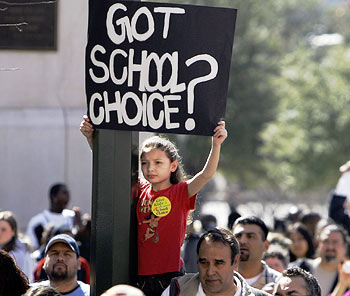
Clearly there is a strong movement to examine public schools by metrics other than simply test scores.  While it appears to be socially acceptable to view some public schools (neighborhood) by more than their test numbers, others (charters) are not afforded the same perspective.  Until we can firmly ascertain what our educational aims are – either creating students who perform well on test as a measure of success, or having students achieve high school graduation and college acceptance be the marker, we will continue to languish in the oftentimes contentious debate over school choice and the numbers game.  While we adults, pundits and prognosticators are having this debate, school children all over the country will continue and are continuing to fall through the cracks.  Perhaps, as Paul Tough and other have begun to articulate, it is time we look at character education, grit, resilience and determination in determining "student success" and not just test scores.

Note: To see an example of "success" as well as the vitriolic tone surrounding this debate, see Op-ed from Chicago Sun-Times from Principal of Urban Prep in Chicago. (http://tinyurl.com/8jg9vg2)

September 18, 2012

"I didn't think it was a game..."

Welcome back from summer vacation.

Right away it seems that this school year has stepped off, or perhaps into, a heap of controversy.  While good things are happening on the personal front for me academically, the blessings afforded me are not being spread through out the educational landscape.  With this said let me re-initiate my blog with a review of a previous blog post and a continuation of the discussion.

My post entitled "We Love that Basketball" (June 4, 2012) was my attempt to link sports analogies with the educational discourse.

In a "conversation" on twitter a woman engaged me in a heated discussion about educational policy which resulted in her using the line which is the title of this post.  I made the argument that the education policy landscape is a game.  I'd also argue that politics as a whole is a game - some would argue, more often than not, a zero-sum game. A zero-sum game is briefly defined as one making gains and the other side making equally similar gains and therefore the total gains are zero.  As a political science major, and policy wonk in both Washington DC and Chicago, I understand the hand to hand combat of politics - for better or worse.  I am also seeped in a deep, philosophical understanding that there are those in education who believe this divisiveness does not exist.  When speaking of education and education policy, they are the ones who generally speak in platitudes such as "all children can learn" or that "everyone deserves a fair shake."  The reality, for many of us, in particular persons of color, is that we know that the world is skewed towards "winners" and "losers."  To deny that this is, for better or worse, the current landscape, is to deny, and I believe disrespect, both the process and its participants, namely children.

We have to acknowledge that there are winners and losers in everything that takes place in the public arena. The goal shouldn't be to deny that the large chess board exists, but rather we should aim towards teaching everyone how to play the game.  The goal shouldn't be trying to espouse false platitudes or unrealistic goals or expectations, but rather fight to close gap between those who are "winning" and those who are "losing."  The most ideal situation would be one in which we are able to not only close the "achievement gap" of the nation's public school students, but also close the "political gap" which exists among many of their teachers.

I have thought long and hard about why what I call the "political gap" among teachers exists.  More to the point, I've often wondered why.  Here's a thought.  Let's look at the numbers in regards to who is teaching our children.  Between 1986 and 2011, the number of male teachers dropped from 31% to 16%.  Further, the race of those who teach our children has continuously been predominantly white 84% (down from 91% in 1986) (http://www.edweek.org/media/pot2011final-blog.pdf).  Consequentially in an increasingly "Browning" country our teaching population is predominantly white females.  For example, in Chicago, the current student population is only 9% white (which is similar to other large school districts such as LA or New York).

Let me be clear, I am not disparaging the work of these teachers, but rather I highlight this to raise a few questions.  One, what role does the teacher's gender and race play in the expectations of their students?  Two, what role does the teacher's gender and race play in their interest or engagement with the oftentimes confrontational and heated arena of politics?  It is noted by folks far more intelligent than I, that women tend to be less confrontational and less interested in politics at the school site for a multitude of reasons, not the least of them being the many other hats they wear as a teacher (mentor, role-model, advisor, counselor, etc...).  As such many teachers tend to do or listen exclusively to the leadership of their union which brings me to the next point.

As I have raised on twitter and elsewhere, this seems to be a huge case of irony. While these same teachers teach students to "challenge authority" and they themselves challenge authority, namely the School Board, the Administration and the like, they seldom seem willing or wanting to challenge their union en masse.  With the exception of large scale turnover of union leadership, which occurs rarely, teachers (regardless of gender) seem content to believe and follow their union.

While I am in favor of both teachers and unions, I do not think that teachers unions, over the past few decades, have served the needs of their rank and file as positively as they could have.  No one can argue that there is an extreme need for infrastructure repairs in many of our crumbling urban schools.  No one can argue that class size should be lower, and that teachers need more autonomy.  The questions are how do we achieve these goals while at the same time, 1) continuing to teach our students to love learning and ask critical questions 2) balancing the budgets and 3) increasing graduation rates and reducing drop out rates?

I do not have the answer, but I do know that more teachers need to examine the leadership of their unions as closely as they scrutinize the schooling choices of their Mayor's children or any of the other multitude of distractionary arguments which have been advanced since Chicago teachers went on strike Monday (9/10).  As this strike thankfully comes to a close, examining the residual effects will be something which will be under the microscope in the next few weeks and months.  It will be interesting to see what becomes of the current leadership of the Chicago Teacher's Union and how the teachers will repair their relationships at the school site.  Trust is key, but also extremely hard to build.

July 9, 2012

Black ain't Nothin' But a Color


Note: I have been trying for weeks to figure out a way to write this idea down in a way that won’t offend too many folks.  Of course I am going to offend some, that’s the nature of raising some of the issues raised on this blog.  However, I seriously want to parse this issue carefully, not to save face or maintain allies in certain places, but rather because I want to treat the issue with the temerity and seriousness it deserves, while also being honest.

With that said…

It has come to my attention that many people (more than I ever knew) are mired in the race based philosophies of an earlier era.  It is not just those in the streets (see Occupy and radicals), but it has unfortunately shown its ugly head in the ivory towers of academic institutions, as well as the public sphere of intellectual conversation/discourse.  What I explicitly mean is too many folk rest on the notion that since the history of America, as this camp so eloquently articulates, was built on the backs of Black and Brown folk that we – those of us who are Black and Brown, must somehow hold this country forever responsible for whatever societal ills which happen to us.  In short, structural, institutional and societal racism has and will always hold us back from achieving the “American dream.” 
            What many who adhere to this belief insist upon is that simple isolated advancements/achievements, from being able to sit/eat/shop/walk anywhere in this country without being legally harassed, not to mention the current (and future) occupant in the White House, do nothing to change the singular insistence that “things have not gotten better, nor will they ever.” 
            I’m sorry, but as I sit here, in Los Angeles, a true melting pot or stew (which, of course has its boiling points and warts) I look out on the block and see a sea of humanity, or as Prince, expanding upon Jesse Jackson, put it, a sea of “rainbow children.”  I know there are undercurrents of anger, resentment and yes racism, but walk into the shops along this block, or enter the place where I just got my hair cut.  See who owns these shops, not just who patronizes them.  If you don’t think change (financial, social and otherwise) has come to many of these entrepreneurs, you are doing a disservice to their hard work, perseverance and dedication.
            As I think about my experiences in my current residence on the other side of the country, I can only think of a few instances and individuals which truly represent the “rainbow children” mentality.  And let me be clear, I am not so much speaking so much to those who have traditionally been in power or were the perpetrators of racism in this country (i.e. white folk), I’m talking to you, my brothas and sistas.
            Since when did it become socially and culturally acceptable in too many places to see race through a singular lens?  If I’m not mistaken, the history teacher in me can examine as far back as DuBois and Washington, or Malcolm and Martin the dichotomy which has existed in the our community.  In short, there are too many examples of what it means to live, act, socialize and thrive as a Black/Brown person to conclude that only one way should be socially acceptable.  What is hurtful for those of us without a home (not fully embraced in either the dominant society or their “home” culture) is that as we advance the ladder – whether it be in business, academia or simply by living in a mixed community, we are further and further excommunicated by our own.          
If those of us who try to present a third way to Black/Brown folk, or actually see the dream King envisioned becoming a reality (albeit not as fast as it should, but no one is drinking out of a segregated water fountain) ever challenge the “norm,” we become pariahs, traitors or liars.  Yet in the dominant world, we are seen as “angry” “dangerous” and “threatening” if we challenge not how far we’ve come, but how much further we still need to go.  In some circles, we are increasingly held to a different standard even if we have the same credentials, same education, live in the same neighborhoods and frequent/enjoy the same cultural artifacts.
            So what is a 21st century brotha/sista to do?  While I personally am not afraid to challenge anyone or, in the same vein, learn and grow from others, I see fear emanating from both sides.  Fear of change.  Fear of the unknown.  Fear of failure.  If we, as Black/Brown folk acknowledge, yes, things have changed since the 1960s, or even the 1980s, we run the risk being dismissed and reduced to an inaccurate conclusion that change has produced a “post racial world.”  If we challenge white folk in the same manner and approach their peers/colleagues do, on an intellectually level playing field, we run the risk of being dismissed as “dangerous” or “threatening.”
            In short, in this day and age, the younger generation doesn’t see race as we once did (or some still do).  What that means is that for them it is OK to like both Drake and Taylor Swift, to eat sushi, tacos and grits all in the same week, or participate in any other culturally hybrid phenomena which exist today.  Maybe we can learn from their hybridity, and maybe they can learn the historical constructs of the past from us.  We have the puzzle pieces in place, now the difficult part of putting them together must take place.  It starts with what the late Rodney King said so famously 20 years ago during civil unrest in LA “Can’t we all just get along?”  Getting along doesn’t mean forgetting the past, it means understanding, acknowledging and as Mandela and the Apartheid Movement has taught us, Ubuntu – “I am what I am because of who we all are.”